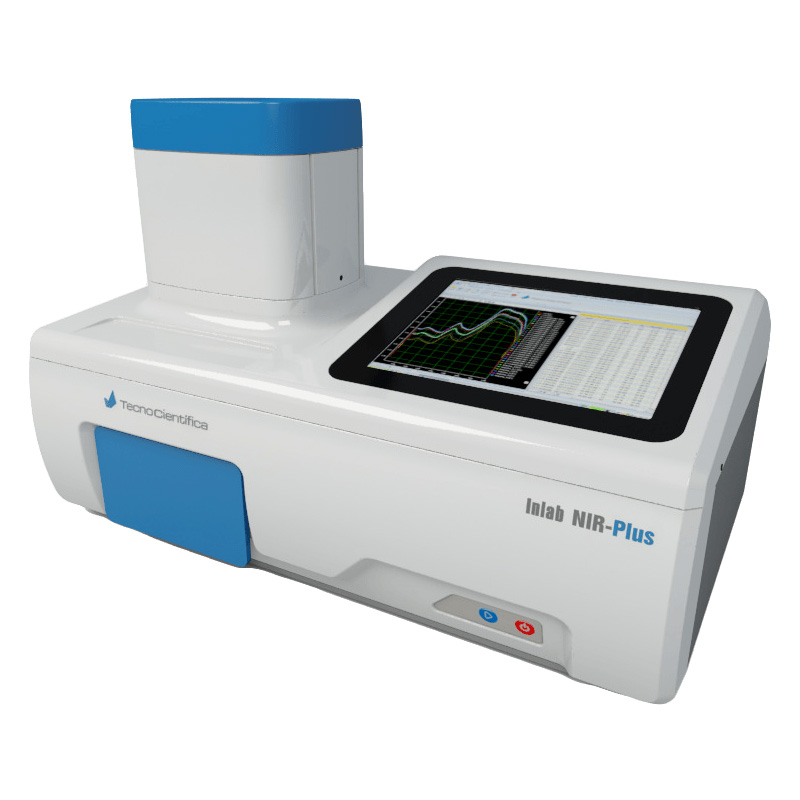
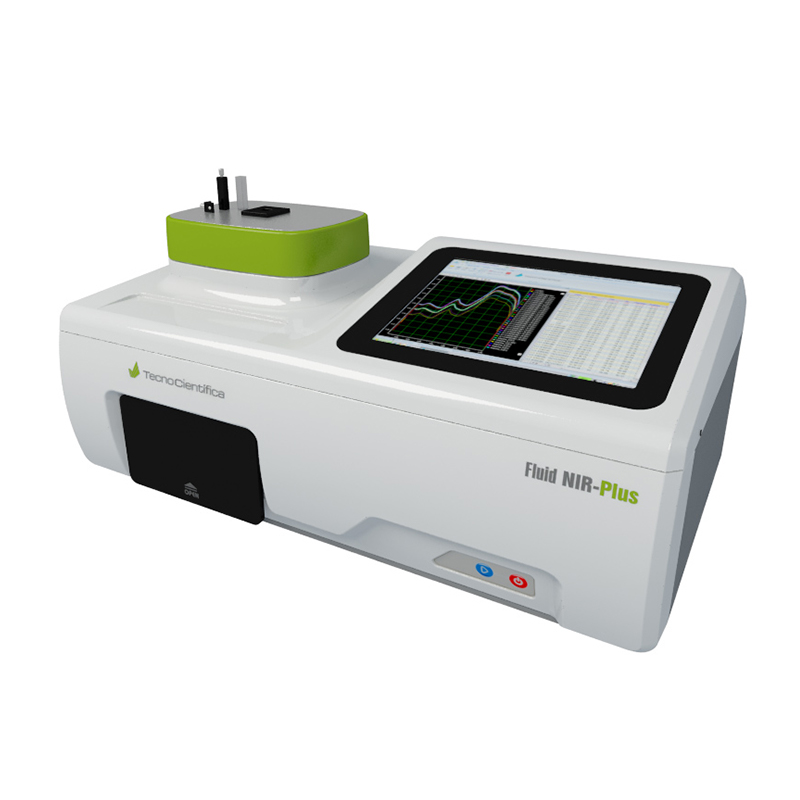
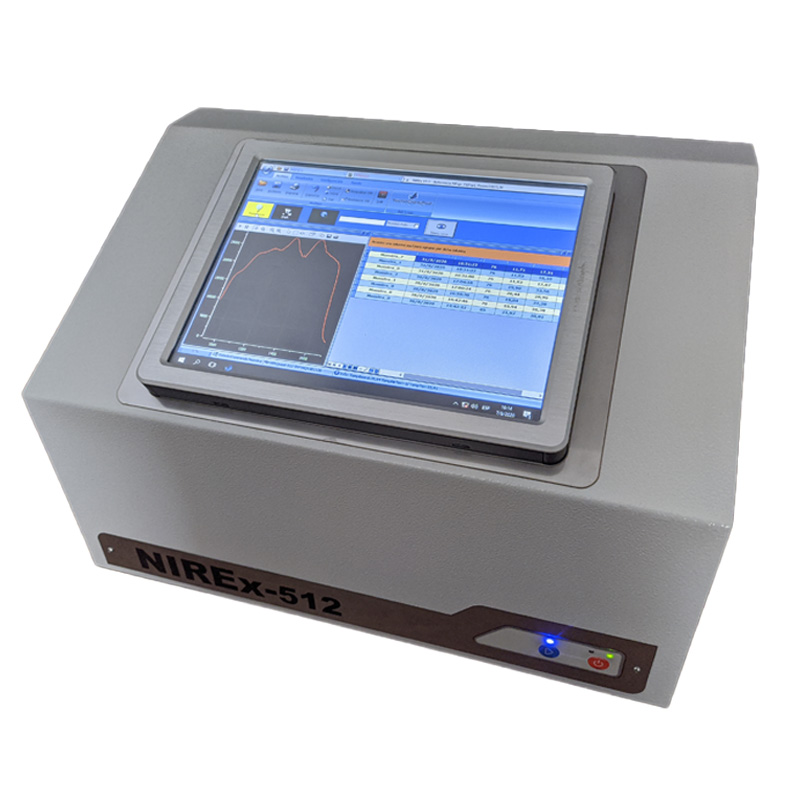
Measuring reflection over this spectral range requires some attention when obtaining the spectra from the sample because the absorption peaks in this region (especially moisture and protein) are weak. Most of the instruments available on the market that are measuring in the same region use transmittance. It is true that in this region, because of the weak signal, working with transmittance gives more stability. However, on the other hand the path length of the light through the sample needs to be controlled very well especially when switching from one product to another. Using our system the stability comes from the management of the continuous flow of the sample and the possibility of obtaining an integrated spectrum which includes a large amount of information about the sample. Using our system the path length is not critical and the process is simpler for the end user.
The measuring time depends on the quantity of sample to be analyzed. The UltraNIR-WGA can handle from 200 cm3 up to 1,000 cm3. Normally this time is between 4 and 9 seconds (full hopper). The capacity of processing a large amount of sample (or small, depending of user requirements) makes the spectral data very representative. Measurements are multi-parametric. This means that in the same analysis you receive all the results of the parameters that are included in the selected product calibration.
The heart of the system is a light disperser which uses the most modern technology to obtain spectral images: detecting instantly and simultaneously the whole spectral range through a CCD (couple charged device). So, there are no optical moving parts (like monochromators) avoiding recalibration because of a misalignment. This disperser is installed in a small integrated Thermo Electrical Controled (TEC) module that keeps its ambient temperature in 20°C +/- 0.1°C optimizing the optical stability of the system.
|